Normalization Watch II
The Silence Between the Sirens


Hello, and welcome to the latest edition of our 50501 CO newsletter!
In this newsletter we provide an update on the efforts of the administration to normalize authoritarianism. In addition, you’ll find information on upcoming activities from the 50501 calendar, actions you can take outside of protesting, and also find out about additional ways to connect with us.
See you on the streets! ✊✊✊
Actions and Activities
(The below list contains details on all actions this week and next week which have been submitted to our 50501 CO calendar; click the link above for more details and the full calendar)
Littleton
11/8: 11:00am - 1:00pm - Protest Against Tyranny (5700 South Broadway)
11/15: 11:00am - 1:00pm - Protest Against Tyranny (5700 South Broadway)
Loveland
11/8: 12:00pm - 2:00pm - Hands Off (US 287 from US34/Sprouts to Tesla)
11/15: 12:00pm - 2:00pm - Hands Off (US 287 from US34/Sprouts to Tesla)
Steamboat Springs
11/6: 5:30pm - 6:30pm - Worth Fighting For - Routt County In-Person Meeting (RSVP for exact location)
Normalization Watch: The Silence Between the Sirens
In July, we published our first Normalization Watch—a running log of the small, steady concessions that make authoritarianism feel ordinary. Three months later, the pace has only quickened. From now on, we’ll do this quarterly, so long as we’re able to keep printing. Because when the record disappears, memory goes with it.
The quarter in plain view
A politicized justice drumbeat.
Since mid-summer, the administration’s retribution campaign has expanded. In late September, former FBI director James Comey was indicted for alleged perjury after the president publicly demanded charges. Last week, New York Attorney General Letitia James was indicted on bank-fraud counts she calls politically motivated. Add to that the ongoing investigations into former Homeland Security officials who criticized immigration raids, and a pattern emerges: critics face prosecution, loyalists receive pardons or promotions.
The Hegseth doctrine.
On September 30, Defense Secretary Pete Hegseth assembled senior officers at Quantico and declared “the era of the Department of Defense is over.” He called for a return to a “War Department mindset,” derided “fat generals,” demanded mandatory fitness tests, and pledged to eliminate what he labeled “gender delusions.” The audience sat silent; there was no ovation, no debate—just a signal that obedience now outranks dissent.
Federal muscle in the cities.
Chicago’s “Operation Midway Blitz,” launched under the banner of “public safety,” put ICE and DHS agents in policing roles until a federal judge issued a two-week restraining order citing constitutional concerns. In Portland, a similar deployment met a partial block on appeal. Washington, D.C., remains under a federal directive invoking Section 740 of the Home Rule Act—ostensibly a crime-control measure, but effectively transferring oversight of the Metropolitan Police Department to the White House. Every move is billed as temporary. None have concluded.
Shutdown consequences.
The federal shutdown began October 1 after Congress failed to pass a funding bill. Agencies are running on emergency authorizations; tens of thousands of federal workers are on furlough, with layoffs announced at the Departments of Interior and Education. Healthcare premiums rise precipitously at the same time funds explicitly set aside to keep the SNAP program functioning during a shutdown are deliberately withheld. What began as brinkmanship is quietly becoming structural: executive discretion replacing legislative budgeting.
The pattern since July
Across these three months, the through-line is acceleration. Indictments of political opponents, loyalty talk in the military, federalized policing, and a drawn-out shutdown have all unfolded faster than the public can process. Each new outrage blurs the last. That’s the tactic—speed as camouflage.
Checks and balances still exist on paper, but their enforcement lags or stalls. Court rulings against the administration go unanswered. Inspectors general are replaced. Congressional oversight dissolves into spectacle. The system hasn’t collapsed; it’s been bypassed.
And yet, people are still out there. Protests continue in Chicago, Portland, Denver, and on campuses from Michigan to California. They’re brave, disciplined, smaller than they should be. Outrage fatigue has become the government’s most reliable ally.
What’s being normalized
The exceptional as routine. Armored vehicles in city centers. Federal “advisors” managing local police.
The political as criminal. Indictments and investigations framed as justice but aimed as warning shots.
The temporary as permanent. Emergency measures that never sunset.
The fatigue as acceptance. The quiet that follows the siren.
How to resist the blur
Keep a record. Save local coverage before “updates” rewrite it. Support regional reporters—they see what nationals miss. Talk to people who’ve tuned out: “Remember July? Here’s what’s changed since then.” The gap between what we recall and what we tolerate is where normalization hides.
The absence of panic isn’t peace.
The quiet isn’t calm.
It’s sedation.
We name what’s happening so we remember it’s not normal.
And we’ll keep naming it—every quarter, for as long as we can.
Non-Protest Actions Bingo
The below bingo card contains a list of actions you can take (other than protesting) to help further the cause. If you get a bingo, tag us on social media to let us know!
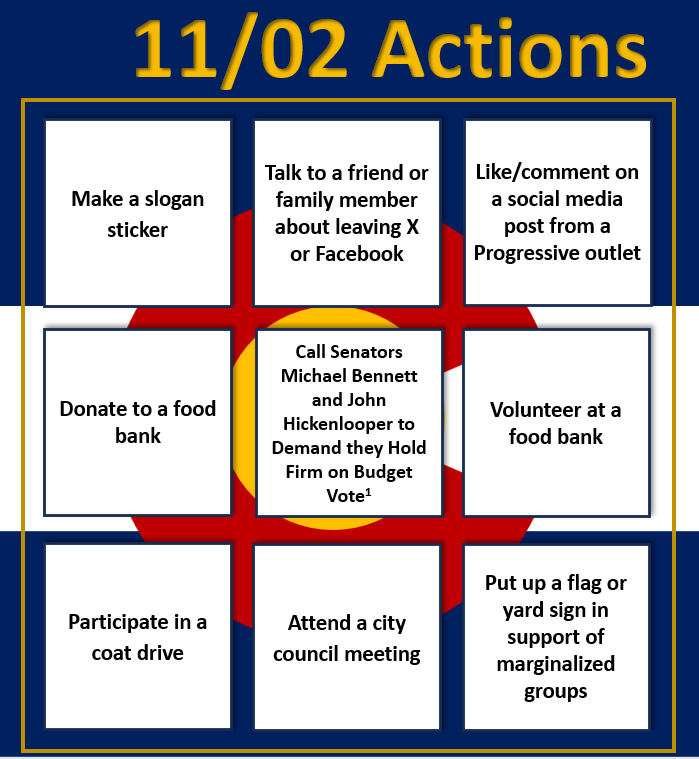
1. As you have likely heard, the United States budget for fiscal year 2026 must be passed before the end of September to avoid a government shutdown. Both Chuck Schumer and Hakeem Jeffries have indicated that they are willing to compromise on passing the budget so long as Affordable Care Act subsidies are added back in. This cannot be the only item they fight for. Democrats have the ability to filibuster the budget in the Senate, and should use it to rein in ICE budgets/behavior, the rampant corruption of the Trump administration, and the use of the Department of Justice as a political hit tool. Call our CO senators and demand that they pressure Schumer and their peers to take a stand for what really matters to you!
Connect with 50501 on Social Media


